
Keep the dirt on the lot
Silt Fence & SWP3 Sediment Control in Houston, TX
Perimeter fence and inlet protection put in to plan and kept up until the ground is seeded.
- On-site measuring and a written, itemized quote at no charge
- Grading, silt fence and seeding handled by one crew
- Seed mixes picked for your sun, shade and soil
Sediment Control on Flat, Wet Sites
Silt fence and SWP3 sediment control is the work that keeps soil from leaving a construction site in Houston before the ground is seeded. We trench in silt fence along the downslope edges of lots and pads, protect storm drain inlets, and maintain those controls as the job goes on. Builders, remodelers, pool contractors and site contractors call us when a stormwater plan calls for sediment controls, when an inspector has flagged fence that is down, or when a project is finally seeded and the fence needs to come out.
What the state requires
Under the TCEQ Construction General Permit, TXR150000, any project that disturbs an acre or more and discharges stormwater to surface water in the state needs coverage. So does a smaller lot when it belongs to a bigger development, built out under one plan, that disturbs an acre or more in total. Small construction activities disturb 1 to under 5 acres; large ones disturb 5 or more. Every operator must develop and put in place a Stormwater Pollution Prevention Plan before construction begins. The SWP3 lays out the best management practices for the site, and on most Houston lots that list leads with silt fence and inlet protection. TCEQ also publishes the site notice forms that permitted operators use.
Why sediment moves so easily here
Houston's flat terrain and low-permeability clay soils mean water sheets across a bare lot instead of soaking in. It carries fine clay and silt with it, and that sediment ends up in street gutters, storm inlets and eventually the bayous. With measurable rain on about 104 days a year at Bush Intercontinental and frequent heavy storms, a fence that is not trenched in or not maintained fails often. Fine clay passes through or under poorly installed fence, so installation details matter more than the fabric itself.
How we install silt fence
We follow the layout in your SWP3 or site plan, running fence across the slope on the low sides of the disturbed area rather than straight down it. Fabric is buried in a trench on the uphill side and backfilled and compacted so water cannot run underneath, and posts are driven at the spacing the plan or product calls for. Where fence has to cross a swale or catch a lot of flow, we use reinforced or wire-backed fence or recommend another control. Ends are turned upslope so water does not simply run around them.
Inlet protection
Curb and area inlets near a site need a barrier, or sediment off the lot ends up in the storm sewer. Depending on the inlet and traffic, we use silt fence barriers, sandbags, gravel and wire mesh, or devices set under the grate. Street inlets need protection that does not create a flooding hazard in heavy rain, which on Houston streets is a real concern.
Maintenance and removal
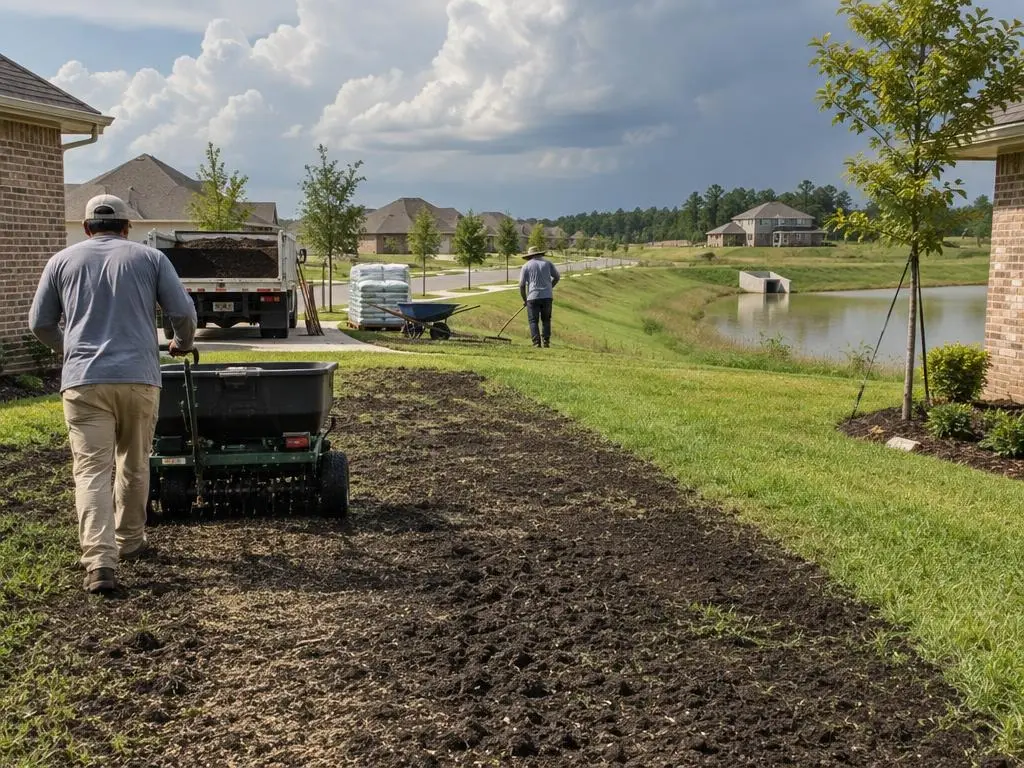
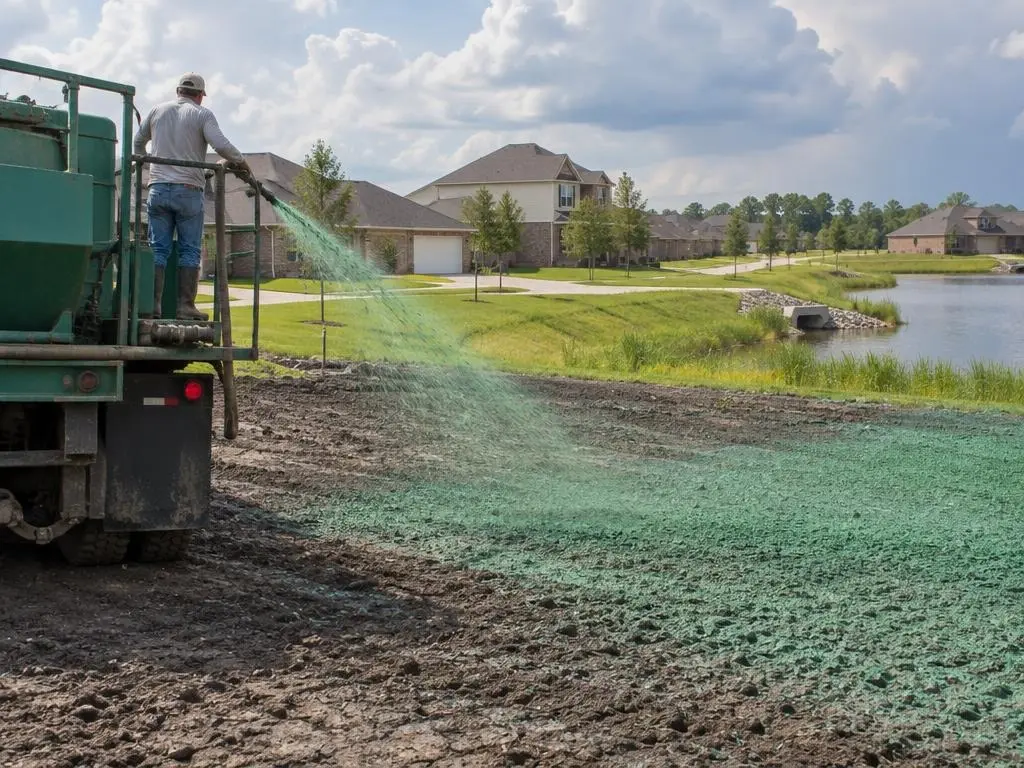
Silt fence is not set-and-forget. Sediment builds up behind it, posts lean, and mowers and trucks knock it down. We can inspect and repair fence on a schedule or after storms, remove built-up sediment, and replace damaged sections. When grass has the site covered, the fabric and stakes come out, we smooth the slot where the fence was buried and spray seed on that strip, so there is no bare line left behind. As silt fence contractors who also hydroseed, we can do the final seeding on the same visit.
Construction entrances and other controls
Silt fence is only one part of most plans. Mud tracked onto the street by trucks is a common complaint, so many SWP3s also call for a stabilized construction entrance at the driveway, along with concrete washout areas and stockpile covers. We focus on fence, inlet protection and the seeding that ends the job, and we coordinate with whoever handles the rest so the controls work together. When a lot changes hands from the site contractor to the builder, fence often gets moved or driven over. A quick walk at that handoff catches gaps before the next storm finds them.
What it costs
A 2025 bid-price sheet from a state highway agency puts plain (unstabilized) silt fence at $378 and stabilized silt fence at $748, both per 100 feet. The same list prices inlet protection at $102 for a silt fence barrier, $141 for sandbags and $172 for gravel and mesh, each. Houston jobs vary with access, soil and how much maintenance is included, so our quote lists installation, upkeep and removal separately.
Sediment Controls We Install
The practices most Houston SWP3s call for.
Silt fence installation
Trenched, backfilled and staked to the layout in your plan.
Reinforced silt fence
Wire-backed fence for longer runs and heavier flow.
Inlet protection
Fence barriers, sandbags, gravel and mesh or under-grate devices.
Inspection and repair
Scheduled or after-storm checks, sediment removal and fixes.
Removal and seeding
Fence pulled and the trench line seeded once the site is stabilized.
Published Sediment Control Rates
| Item and unit | Published rate |
|---|---|
| Silt fence, unstabilized, 100 linear ft (2025 highway-agency bid prices) | $378 |
| Stabilized silt fence, 100 linear ft (same bid sheet) | $748 |
| Silt fence barrier at one inlet (same bid sheet) | $102 |
| Sandbags around one inlet (same bid sheet) | $141 |
| Gravel and wire mesh at one inlet (same bid sheet) | $172 |
Reference rates only. Fence length, inlet count and how long the controls stay up change each Houston job; the signed quote sets the bill.
From Layout to Removal
1. Review the plan
We go over your SWP3 or site plan and walk the lot.
2. Install
Fence trenched and staked, inlets protected.
3. Maintain
Checks and repairs on the schedule you set or after storms.
4. Seed
Disturbed ground hydroseeded when grading is done.
5. Remove
Fence pulled and the line seeded once grass is established.
Why Choose Us for Silt Fence & SWP3 Sediment Control
Trenched, not laid on top
Fabric goes into the ground so water cannot run under it.
Same crew seeds the site
No gap between taking fence down and getting grass up.
Repairs after storms
We can check and fix controls when the rain stops.
Silt Fence & SWP3 Sediment Control Questions
Does a one-lot home build in Houston fall under the TCEQ construction permit?
TCEQ says permit coverage is not required when a project disturbs less than an acre and does not belong to a bigger development being built under one plan. A lot inside a subdivision that is still being built out usually does belong to one, so the subdivision's total acreage counts. Your builder or site operator should know which applies.
What is an SWP3?
A Stormwater Pollution Prevention Plan. TCEQ requires operators covered by the construction general permit to develop and implement one before work starts. It describes the site and the controls, such as silt fence and inlet protection, used to keep pollutants out of runoff.
Why does silt fence fail on Houston sites?
Usually because it was not trenched in, so water runs underneath, or because sediment has built up behind it and nobody cleared it. Fence run straight downhill or across a concentrated flow path also fails. Correct layout and regular upkeep solve most of it.
Can you take over maintenance on fence someone else installed?
Yes. We inspect what is there, repair or replace sections that are not doing the job, and keep it up through the rest of construction.
When can silt fence be removed?
When the area it protects is stabilized, typically with established grass, and your plan or inspector agrees. We remove it and seed the trench line.
Silt Fence & SWP3 Sediment Control Service Areas
- Hydroseeding in Houston, TX
- Hydroseeding in Katy, TX
- Hydroseeding in Sugar Land, TX
- Hydroseeding in The Woodlands, TX
- Hydroseeding in Conroe, TX
- Hydroseeding in Pearland, TX
- Hydroseeding in League City, TX
- Hydroseeding in Friendswood, TX
- Hydroseeding in Missouri City, TX
- Hydroseeding in Cypress, TX
- Hydroseeding in Tomball, TX
- Hydroseeding in Humble, TX
- Hydroseeding in Kingwood, TX
- Hydroseeding in Spring, TX
- Hydroseeding in Baytown, TX
- Hydroseeding in Pasadena, TX
- Hydroseeding in La Porte, TX
- Hydroseeding in Richmond, TX
- Hydroseeding in Fulshear, TX
- Hydroseeding in Manvel, TX
- Hydroseeding in Alvin, TX
- Hydroseeding in Magnolia, TX
- Hydroseeding in Montgomery, TX
- Hydroseeding in Dickinson, TX
Get a Silt Fence & SWP3 Sediment Control Estimate
Send the SWP3 map or a site plan. We will price installation, upkeep and removal.