
Bayou City ground
Hydroseeding in Houston, TX
Flat land, tight clay and roughly 50 inches of rain a year. Seed has to be planned around all three.
- On-site measuring and a written, itemized quote at no charge
- Grading, silt fence and seeding handled by one crew
- Seed mixes picked for your sun, shade and soil
Growing Grass on Gulf Coastal Plain Clay
Hydroseeding in Houston starts with the dirt. Most of the city sits on the Gulf coastal plain, and Wikipedia describes the surface as low-permeability clay-silt prairie soil over unconsolidated clays and sands that run miles deep. Water does not soak into that ground quickly, and on land this flat it does not run off quickly either. A seed slurry sprayed onto packed clay can float off in the first storm unless the surface is loosened, crowned and covered in hydromulch that grips it.
Why the soil prep matters more here
On a new Houston lot we look at three things before we load the tank: how hard the pad was compacted, where water sits after a rain, and whether the topsoil is real topsoil or spread clay. Ripping the top few inches and adding a thin layer of screened topsoil gives roots a place to go. Without that, Bermuda or St. Augustine seedlings stay shallow and burn out in July.
Working with the rainy season
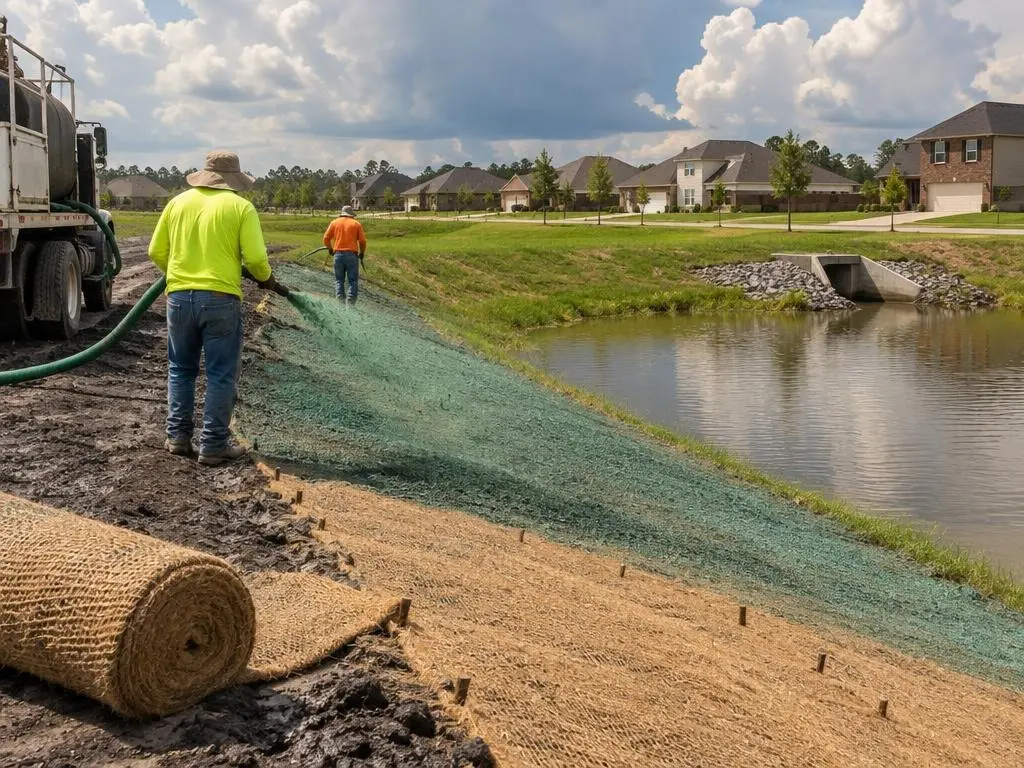
The city averages about 49.8 inches of rain a year, with the bulk arriving between April and October. That wet stretch overlaps the warm-season growing window, which helps germination but also means a fresh seedbed gets hit by heavy afternoon storms. On sloped swales and detention basin banks we use a heavier fiber mulch or a bonded fiber matrix instead of a light paper mulch so the seed stays put.
A long growing season
NOAA normals quoted on the city's Wikipedia page put the frost window between early December and late February, which leaves a growing season of about 286 days. That gives you a lot of room to plant warm-season grass, but seed sprayed in late fall will sit dormant. For most lawns we aim for spring through early fall, and use a winter cover or temporary erosion control on construction sites that cannot wait.
Flood rules and grading
After Hurricane Harvey the city passed a 2018 rule requiring new homes in the 100-year and 500-year floodplains to be built two feet above the 500-year flood level. Raised pads leave steep side slopes around foundations. Those slopes are exactly where hydroseeding with a tackifier, or straw blankets on the steepest pitch, earns its keep.
What we handle across the city
- New lawn hydroseeding for infill houses and townhome yards
- Swale, ditch and detention pond seeding for builders
- Silt fence installation and inlet protection on active lots
- Loosening gumbo clay, fine grading and screened topsoil ahead of the slurry
For an inside-the-Loop yard or a builder pond, call (832) 772-4979 or use the estimate form.
Houston Ground Conditions
- Prairie clay. Wikipedia notes that much of Houston has ubiquitous low-permeability clay-silt prairie soils, which add to localized flooding on flat ground.
- Rainfall. Houston averages about 49.8 inches of rain a year (1981 to 2010 records), with most falling April through October.
- Growing season. Freezes at Bush Intercontinental usually fall between December 3 and February 20, giving a growing season of about 286 days.
- Elevation. Downtown is about 50 feet above sea level and the highest ground in far northwest Houston is about 150 feet.
- Floodplain rule. A 2018 city rule requires new homes in the 100- and 500-year floodplains to sit two feet above the 500-year flood level.
Houston Questions
Will hydroseed take on Houston gumbo clay?
Yes, if the surface is loosened first. Spraying onto compacted clay is the most common reason seed washes off or dies young. We rip or till the top layer and add topsoil where the pad is bare clay.
Which months give hydroseed the best start in Houston's heat?
Warm-season grasses germinate best once soil temperatures climb in spring, so April through early September is the usual window. Fall seeding works for erosion cover but expect slower green-up.
Do raised flood pads need anything special?
The side slopes around elevated pads are steeper than a normal yard. We use a heavier mulch with tackifier, and blankets where the slope is too steep for mulch alone.
Can you seed a detention pond or ditch?
Yes. Detention basin side slopes and roadside ditches are a big part of builder work in Houston, and they usually get a bonded fiber matrix or blanket rather than a light mulch.
Free Estimates in Houston, TX
We come out to look at the yard and put the price in writing, at no charge, anywhere in Houston.
Hydroseeding Near Houston
- Hydroseeding in Katy, TX
- Hydroseeding in Sugar Land, TX
- Hydroseeding in The Woodlands, TX
- Hydroseeding in Conroe, TX
- Hydroseeding in Pearland, TX
- Hydroseeding in League City, TX
- Hydroseeding in Friendswood, TX
- Hydroseeding in Missouri City, TX
- Hydroseeding in Cypress, TX
- Hydroseeding in Tomball, TX
- Hydroseeding in Humble, TX
- Hydroseeding in Kingwood, TX
- Hydroseeding in Spring, TX
- Hydroseeding in Baytown, TX
- Hydroseeding in Pasadena, TX
- Hydroseeding in La Porte, TX
- Hydroseeding in Richmond, TX
- Hydroseeding in Fulshear, TX
- Hydroseeding in Manvel, TX
- Hydroseeding in Alvin, TX
- Hydroseeding in Magnolia, TX
- Hydroseeding in Montgomery, TX
- Hydroseeding in Dickinson, TX