
Seed, mulch and soil work on the coastal prairie
Hydroseeding in Houston, TX
Bermuda lawns, builder lots and pond banks seeded for flat clay ground and more than 50 inches of rain a year.
- On-site measuring and a written, itemized quote at no charge
- Grading, silt fence and seeding handled by one crew
- Seed mixes picked for your sun, shade and soil
Growing Grass on Flat Clay in a Wet Climate
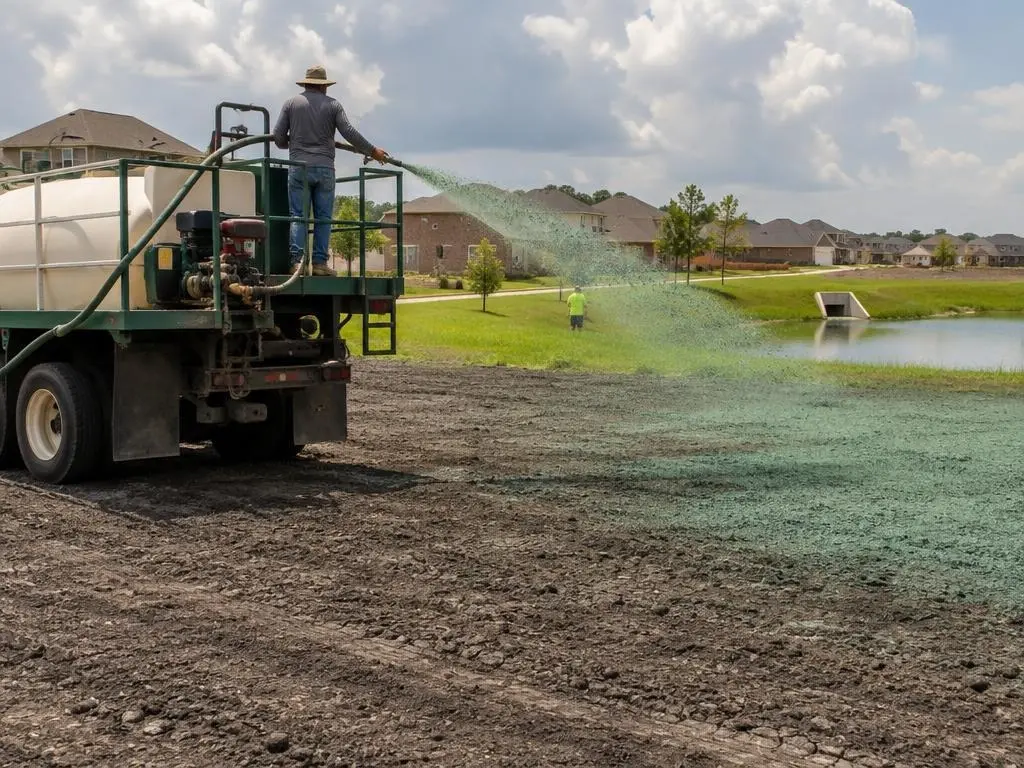
Hydroseeding in Houston is mostly a contest with water. The city sits on the Gulf coastal plain, downtown is only about 50 feet above sea level, and much of town is underlain by what Wikipedia calls low-permeability clay-silt prairie soils. Rain on bare dirt here does not soak in fast, and on a flat lot it does not run off fast either. It sits, then it slides sideways and takes the top of your seedbed along. Elite Hydroseeding Houston loosens and preps the soil, then sprays on one slurry carrying seed, fertilizer, fiber mulch and a tackifier, so the seed is stuck down and covered the day it goes on. We seed new yards, builder lots, commercial pads, detention pond banks and ditch slopes, and we do the grading, topsoil and silt fence that come before the seed.
What sits under a Houston lawn
Below the surface are unconsolidated clays, clay shales and poorly cemented sands laid down by rivers carrying sediment off the Rocky Mountains. The ecoregion around the city, the Western Gulf coastal grasslands, is known for poor internal drainage, with alfisols and vertisols common and sandier, siltier ground mostly along floodplains. In a yard that means two different jobs. On heavy clay, a new lawn needs a grade that moves water off, a loosened top layer so roots can get in, and mulch that holds up when the ground stays wet for days. Near bayous and creeks the soil drains better but washes more easily, so the cover has to bind tighter. The thick, sometimes black surface soil that grew rice on the edges of town grows grass well once it is shaped right.
Rain, heat and the first three weeks
NOAA's 1991 to 2020 normals put average rainfall at 51.84 inches a year at Bush Intercontinental and 55.62 inches at Hobby, closer to the bay. June is the wettest month at Bush with 6.00 inches, followed by October and May; February is the driest. Measurable rain falls on about 104 days a year, so almost any germination window includes a storm. Heat is the other half. Houston averages 106.5 days a year at or above 90 degrees, and summer mornings average over 90 percent humidity. Hydromulch helps with both: it takes the hit from a downpour and keeps the surface damp between waterings. Houston knows what extreme rain does to open ground, from 12 inches in 10 hours in the 2015 Memorial Day flood to more than 50 inches in parts of the region during Hurricane Harvey.
Which grasses start well from seed here
Most seeded lawns in Houston are bermudagrass. It spreads by seed, above-ground runners and underground rhizomes, starts growing actively once temperatures stay above about 59 degrees, and grows best between 75 and 99. It wants full sun; dense shade, especially near tree trunks, holds it back. St. Augustine, the other common Houston lawn, is a different case. Commercially viable St. Augustine seed has only recently become available, so those lawns have almost always started from sod, plugs or sprigs. If your yard sits under live oaks or pines, we will talk about sod or a mixed plan for the shady part. For open acreage, pond banks and drainage easements we also seed native coastal prairie grasses such as little bluestem, big bluestem, Indiangrass and switchgrass, the tallgrass species of the original Texas coastal prairie.
Picking a seeding month
Bush Intercontinental sees about 13 nights a year at or below freezing, usually between December 3 and February 20, which gives a growing season of about 286 days. Daily mean temperatures climb from 63.8 degrees in March to 70.0 in April and 77.4 in May, and that is when bermuda takes off. Extension guidance puts warm-season seeding in late spring to early summer, and that is our main window: April through June gives a new lawn the whole summer to root before nights cool. July and August seeding works with steady irrigation. Early fall is possible but leaves less growing time. In winter we can still lay hydromulch with a temporary cover crop on a site that cannot wait, then seed bermuda in spring.
Sod, hydroseed or a bag of seed
Sod gives a finished look the day it is laid, and in Houston it is the usual route to a St. Augustine lawn. It also costs the most: HomeGuide lists sod at $1 to $4 per square foot against $0.12 to $0.35 for hydroseeding. Dry seed from a spreader costs least, but on bare clay it washes into low spots and birds take a share. University of Nebraska Extension notes hydroseeded grass usually breaks the surface within 5 to 7 days; broadcast dry seed is typically a two- to three-week wait. Hydroseeding lands in the middle on price and is the practical pick for bermuda lawns, big lots, slopes and any ground that has to be covered quickly. Most lawns are ready for a first mow four to six weeks after seeding.
Construction sites and stormwater rules
A project that disturbs an acre or more and drains to Texas surface water falls under the TCEQ Construction General Permit, TXR150000, renewed effective March 5, 2023. One to five acres is a small construction activity and five or more is large, and TCEQ adds up the disturbed acreage of a whole development built under one plan, so a single lot in a big subdivision can be covered. Operators need a Stormwater Pollution Prevention Plan in place before work starts. We install the silt fence, inlet protection and seeding those plans call for. Inside the city, the 2018 floodplain rule puts new homes in the 100- and 500-year floodplains two feet above the 500-year flood level, which often means raised pads with side slopes that need fast cover.
How a job goes
- We visit, measure, and check slope, drainage, sun and soil
- Your quote comes in writing, with site prep, seed and erosion control each priced on its own line
- We grade, loosen packed clay and bring in topsoil on the thin spots
- The slurry goes on in one pass, heavier on slopes and swales
- You get a watering schedule written for the month we seeded
To book that first visit, call (832) 772-4979.
Our Services
Six hydroseeding services and the soil work around them, from one backyard to a subdivision's detention pond.
New Yard Hydroseeding
Bermuda lawns sprayed onto new-build lots, stripped yards and flood-damaged ground.
Learn more →Subdivision & Commercial Hydroseeding
Acreage seeding for builders, site contractors, detention basins and commercial pads.
Learn more →Detention Pond & Slope Erosion Control
Blankets, hydromulch and bonded fiber on pond banks, ditches, swales and raised-pad slopes.
Learn more →Silt Fence & SWP3 Sediment Control
Silt fence installation, inlet protection and upkeep for sites under a TCEQ stormwater plan.
Learn more →Drainage Grading & Topsoil
Dirt work, topsoil, and yard or land grading that sends water off the lot before seed goes on.
Learn more →Storm Lawn Repair & Reseeding
Lawn repair, renovation and overseeding after floods, storms, chinch bugs or construction damage.
Learn more →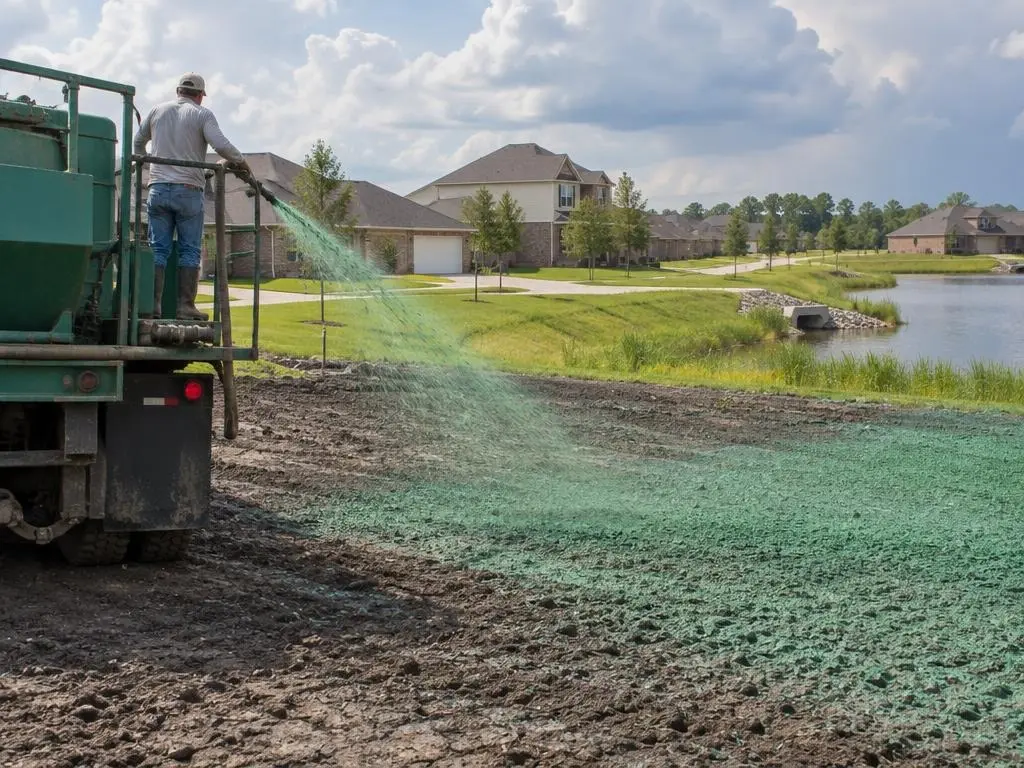
Neighborhoods and Suburbs on Our Route
We work inside Houston and out through Harris, Fort Bend, Montgomery, Brazoria and Galveston counties. West of the city, Katy, Fulshear and Cypress are old rice and ranch country now filling with new subdivisions, while Richmond and Sugar Land sit close to the Brazos. South of town, Pearland, Manvel, Alvin and Missouri City have flat, slow-draining lots, many built around ponds and lakes. To the north, The Woodlands, Spring, Tomball, Conroe, Magnolia and Montgomery bring pine shade, a bit more slope and runoff headed for creeks and Lake Conroe. Kingwood and Humble drain toward Lake Houston. On the bay side, Pasadena, La Porte, Baytown, League City, Friendswood and Dickinson get the heaviest rain and the most storm-repair work. Pick your town for what we watch for there, or call if yours is not listed.
- Hydroseeding in Houston, TX
- Hydroseeding in Katy, TX
- Hydroseeding in Sugar Land, TX
- Hydroseeding in The Woodlands, TX
- Hydroseeding in Conroe, TX
- Hydroseeding in Pearland, TX
- Hydroseeding in League City, TX
- Hydroseeding in Friendswood, TX
- Hydroseeding in Missouri City, TX
- Hydroseeding in Cypress, TX
- Hydroseeding in Tomball, TX
- Hydroseeding in Humble, TX
- Hydroseeding in Kingwood, TX
- Hydroseeding in Spring, TX
- Hydroseeding in Baytown, TX
- Hydroseeding in Pasadena, TX
- Hydroseeding in La Porte, TX
- Hydroseeding in Richmond, TX
- Hydroseeding in Fulshear, TX
- Hydroseeding in Manvel, TX
- Hydroseeding in Alvin, TX
- Hydroseeding in Magnolia, TX
- Hydroseeding in Montgomery, TX
- Hydroseeding in Dickinson, TX
Why Homeowners Call Elite Hydroseeding Houston
Prep and seed from one crew
Grading, topsoil, silt fence and hydroseeding are all ours, so the slurry is not waiting on another company to finish.
Seed matched to the yard
Bermuda for open sun, native prairie grasses for ponds and acreage, and a straight answer when sod suits a shady St. Augustine yard better.
Mixes built for wet ground
Slopes, swales and pond banks get heavier mulch, more tackifier or blankets, because a June storm can arrive before roots do.
Itemized written quotes
Prep, seed, mulch and erosion control sit on separate lines, so it is clear what each part of the job costs.
Common Questions
What is the best type of grass for a hydroseeded lawn in Houston?
For a sunny yard, bermudagrass. It seeds reliably, grows hardest in the 75 to 99 degree range Houston has most of the year, and spreads to fill thin spots. St. Augustine is the other popular Houston lawn, but it has usually been started from sod or plugs because viable seed only recently became available. In heavy shade, neither seeded bermuda nor a quick fix works well, and we will talk through options.
What are the negatives of hydroseeding?
You do not get an instant lawn. It takes about 5 to 7 days to see grass, and the mower should stay in the garage for four to six weeks. You have to water faithfully for the first few weeks and keep foot traffic off. A big storm in the first days can wash a low corner. And it is not the right method for St. Augustine, which is still mostly sodded.
How much does it cost to hydroseed 10,000 square feet?
Angi lists $700 to $2,200 for about 10,000 square feet. HomeGuide's national range, $0.12 to $0.35 for each square foot, works out higher. Grading, topsoil and slope add to that, and we quote prep separately. The total we write on the quote after measuring, once you sign it, is the amount you are billed.
Can you hydroseed in the middle of a Houston summer?
Yes. Bermuda germinates fastest in heat. The catch is water: the surface dries quickly in July and August, so the yard needs irrigation or a hose schedule you can keep. If watering is hard to manage, April through June is easier.
Does a single new-home lot need a TCEQ stormwater permit?
On its own, a project under one acre does not need coverage under TCEQ's construction general permit. But if the lot sits inside a bigger development that is being built out under one plan, such as a subdivision, the disturbed acreage of the whole development counts. Your builder or site operator will know whether the project has a stormwater plan.
Will a heavy rain wash away new hydroseed?
The tackifier and fiber mulch are there to stop that, and on flat ground they usually hold through ordinary storms. Concentrated flow is the risk: a downspout, a swale or a slope that funnels water. We grade those spots, add more mulch or a blanket, and touch up any washed areas.
How soon can a yard be reseeded after it floods?
Once the water is gone and the soil has dried enough to work without smearing. Flood debris and any thick silt layer come off first, and we check that the grade still drains away from the house. Then it is seeded like any bare yard.
Bare Ground After the Build? Let's Measure It
Phone us or fill in the form, and we will book a day to walk your yard or job site.