
Where water runs, soil moves
Detention Pond & Slope Erosion Control in Houston, TX
Banks, ditches and swales covered so the next storm does not carry them off.
- On-site measuring and a written, itemized quote at no charge
- Grading, silt fence and seeding handled by one crew
- Seed mixes picked for your sun, shade and soil
Holding Soil Where Runoff Concentrates
Detention pond and slope erosion control is the part of our work aimed at the places where Houston's flat ground stops being flat: pond banks, ditch lines, swales, channel sides and the slopes around raised house pads. Water picks up speed on any incline, and on bare clay that means rills, then gullies, then a bank that slumps into the pond. Our erosion control services come down to one job: to get those surfaces covered with something that holds before grass roots can, and then to get grass growing through it.
Why Houston needs so much of it
The area drains through four major bayous and an extensive built drainage system, and the prairie around the city drains into it. Wikipedia notes there have been more casualties and property loss from floods in Houston than in any other locality in the United States. Developers answer that with detention. A new subdivision often has one or more ponds with long side slopes, plus channels carrying runoff to them. Homes built under the city's 2018 floodplain rule sit two feet above the 500-year flood level, so many new lots have built-up pads with slopes on every side. All of that is bare soil at the end of construction, and much of it faces running water within weeks.
Matching the cover to the slope
For gentle slopes and swale edges, standard hydromulch with seed is usually enough. On steeper or longer slopes and where water runs along the surface, we move up to a heavier mulch rate with more tackifier, or to bonded fiber matrix, which sprays on like hydromulch but cures into a tougher, continuous layer. Hydro mulching covers most of it. Where flow is concentrated, such as a channel bottom, an outfall or the face of a pond bank below the high-water line, we roll out erosion control blankets: straw blankets for moderate flow, straw-coconut or full coir blankets where they need to last longer. Blankets are pinned with staples and seeded underneath so grass grows up through them.
Soil and water levels
The clays that dominate the Houston area drain poorly, and sandier, siltier soils turn up mainly along floodplains and creeks. Sandy bank soils erode quickly once water starts moving; heavy clay holds a cut better but stays slick and wet after a storm. Before we cover a pond bank, we look at where the normal water level sits and where the high-water marks are, because the band between them gets the hardest use. That band often gets blankets even when the slope above is only hydromulched.
Slope stabilization on home lots
Not every slope is commercial. Homeowners call about a raised pad that keeps washing at the corners, a backyard that drops to a drainage ditch, or a bank behind the fence that ends at a bayou. On those, we regrade if the slope is too steep to hold, cover with hydromulch or blankets, and seed with bermuda in sun. Where the slope is shaded or hard to mow, native coastal prairie grasses such as little bluestem or switchgrass are an option worth discussing. They are the tallgrass species of the original Texas coastal prairie.
When to do it
The sooner the better, but timing still matters for grass. Bermuda grows actively above about 59 degrees, so seed in spring and summer establishes fastest. In winter, blankets and hydromulch with a temporary cover crop hold the soil until spring seeding. With Bush Intercontinental averaging around 104 days of measurable rain a year and the wettest months in late spring and fall, there is rarely a long dry spell to wait for.
Ditches, swales and outfalls
Roadside ditches and backyard swales carry water a few times a month in the wet season and sit dry the rest of the time. That on-off pattern is hard on bare soil: each flow cuts a little deeper, and the dry spells keep grass from rooting before the next one. We shape the ditch so the bottom is wide and smooth rather than V-shaped, line the flow path with a blanket, and hydroseed the side slopes. At outfalls, where a pipe empties into a channel or pond, the soil right below the pipe takes the hardest hit, so it gets the toughest blanket we use and is checked after the first big storm.
Pricing
Blankets and specialty mulches are priced by area. Erosion items on a 2025 bid-price sheet published by a state highway agency include sprayed wood-fiber mulch at $98, straw-coconut blankets at $468 and coir blankets at $532, each figure covering 1,000 square feet installed. We did not find a current published figure for bonded fiber matrix, so that is set once we measure. Slope length, access for the truck and how much regrading is needed move the price as well.
Erosion Control Methods We Use
Picked by slope, soil and how hard the water hits.
Hydromulch with seed
Fiber mulch and tackifier for gentle slopes, swale edges and pad sides.
Bonded fiber matrix
A heavier sprayed cover that cures in place on steep or long slopes.
Straw erosion control blankets
Pinned blankets for moderate flow and shorter-term protection.
Straw-coconut and coir blankets
Longer-lasting blankets for channel bottoms, outfalls and pond waterlines.
Bank and pad regrading
Cutting back slopes that are too steep to hold cover.
Native grass seeding
Coastal prairie grasses for banks and easements that will not be mowed often.
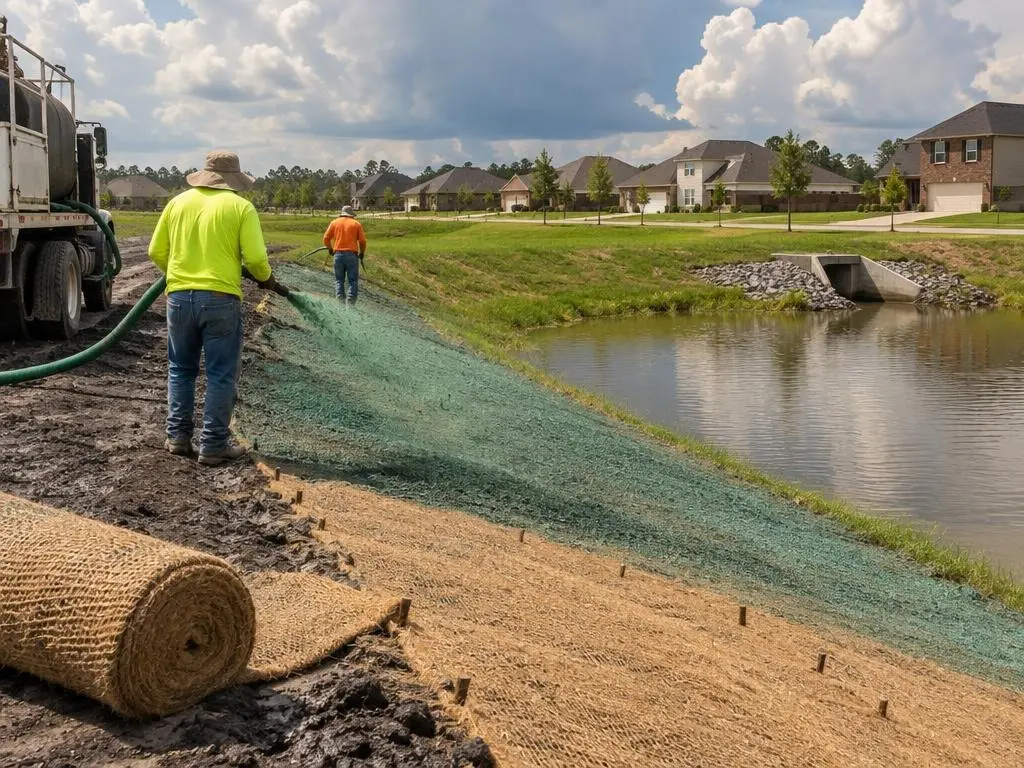
Published Erosion Control Rates
| Item and unit | Published rate |
|---|---|
| Sprayed wood-fiber mulch, 1,000 sq ft (2025 highway-agency bid prices) | $98 |
| 70/30 straw and coconut blanket, laid, 1,000 sq ft (same bid sheet) | $468 |
| Coconut-fiber (coir) blanket, laid, 1,000 sq ft (same bid sheet) | $532 |
| Hydroseeding surcharge for steep banks, per sq ft (HomeGuide) | $0.05 to $0.10 |
| Bonded fiber matrix | No current published figure; quoted on site |
These are outside reference rates, not ours. Bank height, pitch and truck access drive each pond or ditch job, and we bill exactly what the signed quote shows.
How We Stabilize a Bank or Slope
1. Read the water
We look at where runoff comes from, where it concentrates and the normal and high water lines.
2. Pick the cover
Hydromulch, bonded fiber or blankets, by zone.
3. Shape the slope
Regrade or fill rills so cover sits tight on the soil.
4. Seed and cover
Seed goes down first or in the slurry; blankets are stapled over it.
5. Check after storms
We look at the first heavy rain and repair any breaks.
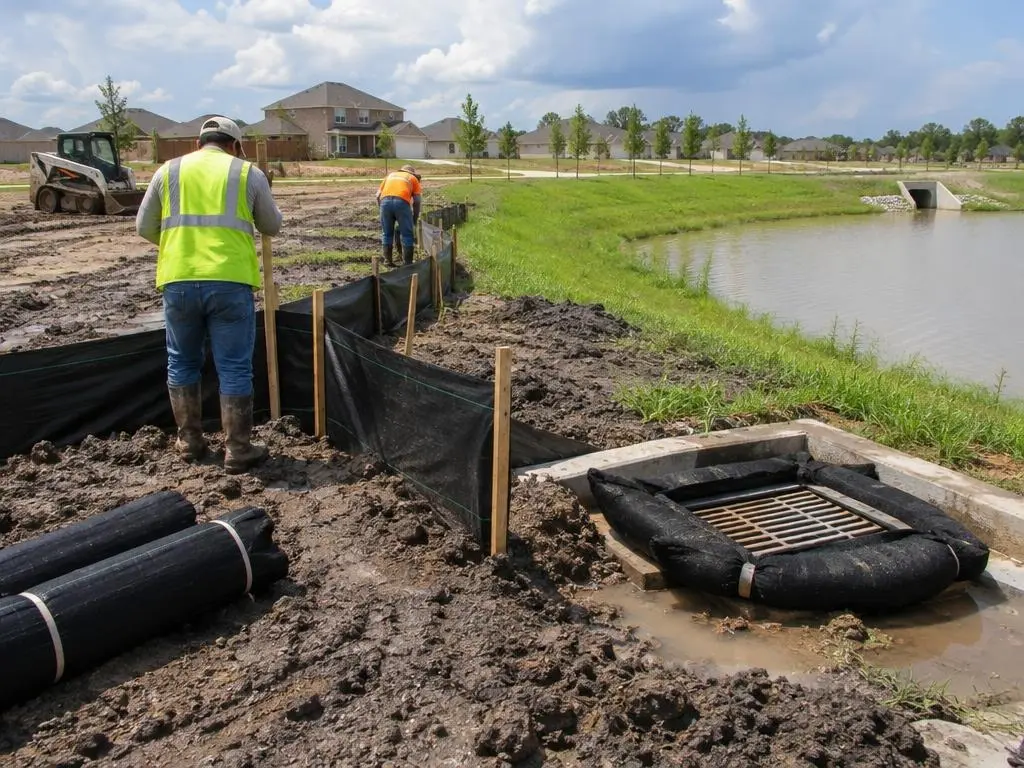
Why Choose Us for Detention Pond & Slope Erosion Control
Cover matched by zone
The waterline, the slope face and the top of bank do not all get the same product.
Grading in house
We can cut back a slope that is too steep before covering it.
Native options
Prairie grasses for banks nobody wants to mow.
Detention Pond & Slope Erosion Control Questions
Should my Houston pond bank get hydromulch or bonded fiber matrix?
Both are sprayed. Hydromulch is fiber mulch and tackifier that holds seed and soil on gentler ground. Bonded fiber matrix uses more binder and cures into a tougher, continuous layer, so it holds up on steeper slopes and under heavier rain.
My pond bank keeps sliding into the water. Will seed fix it?
Seed alone rarely does. The slope may need to be cut back, and the band near the waterline usually needs blankets. We look at the bank and recommend the combination that will hold.
Are erosion control blankets ugly?
For the first months you see the netting. Grass grows up through the blanket, and the straw or coir breaks down over time. In a season or two most people cannot tell it is there.
Who maintains a subdivision detention pond in Houston?
It depends on who owns the pond, which the plat or your HOA documents should show. We work for whoever is responsible and can quote repairs to eroded banks.
Detention Pond & Slope Erosion Control Service Areas
- Hydroseeding in Houston, TX
- Hydroseeding in Katy, TX
- Hydroseeding in Sugar Land, TX
- Hydroseeding in The Woodlands, TX
- Hydroseeding in Conroe, TX
- Hydroseeding in Pearland, TX
- Hydroseeding in League City, TX
- Hydroseeding in Friendswood, TX
- Hydroseeding in Missouri City, TX
- Hydroseeding in Cypress, TX
- Hydroseeding in Tomball, TX
- Hydroseeding in Humble, TX
- Hydroseeding in Kingwood, TX
- Hydroseeding in Spring, TX
- Hydroseeding in Baytown, TX
- Hydroseeding in Pasadena, TX
- Hydroseeding in La Porte, TX
- Hydroseeding in Richmond, TX
- Hydroseeding in Fulshear, TX
- Hydroseeding in Manvel, TX
- Hydroseeding in Alvin, TX
- Hydroseeding in Magnolia, TX
- Hydroseeding in Montgomery, TX
- Hydroseeding in Dickinson, TX
Get a Detention Pond & Slope Erosion Control Estimate
Send a photo of the bank or slope and where water comes from. We will come look.